
Ray tracing has become one of the most exciting technologies in modern PC gaming because it makes virtual worlds look more realistic. From reflections on wet streets to natural shadows and lifelike lighting, this technology can significantly improve the visual quality of supported games. However, these advanced effects require powerful hardware to run smoothly. This raises an important question for gamers who want both excellent graphics and strong performance. 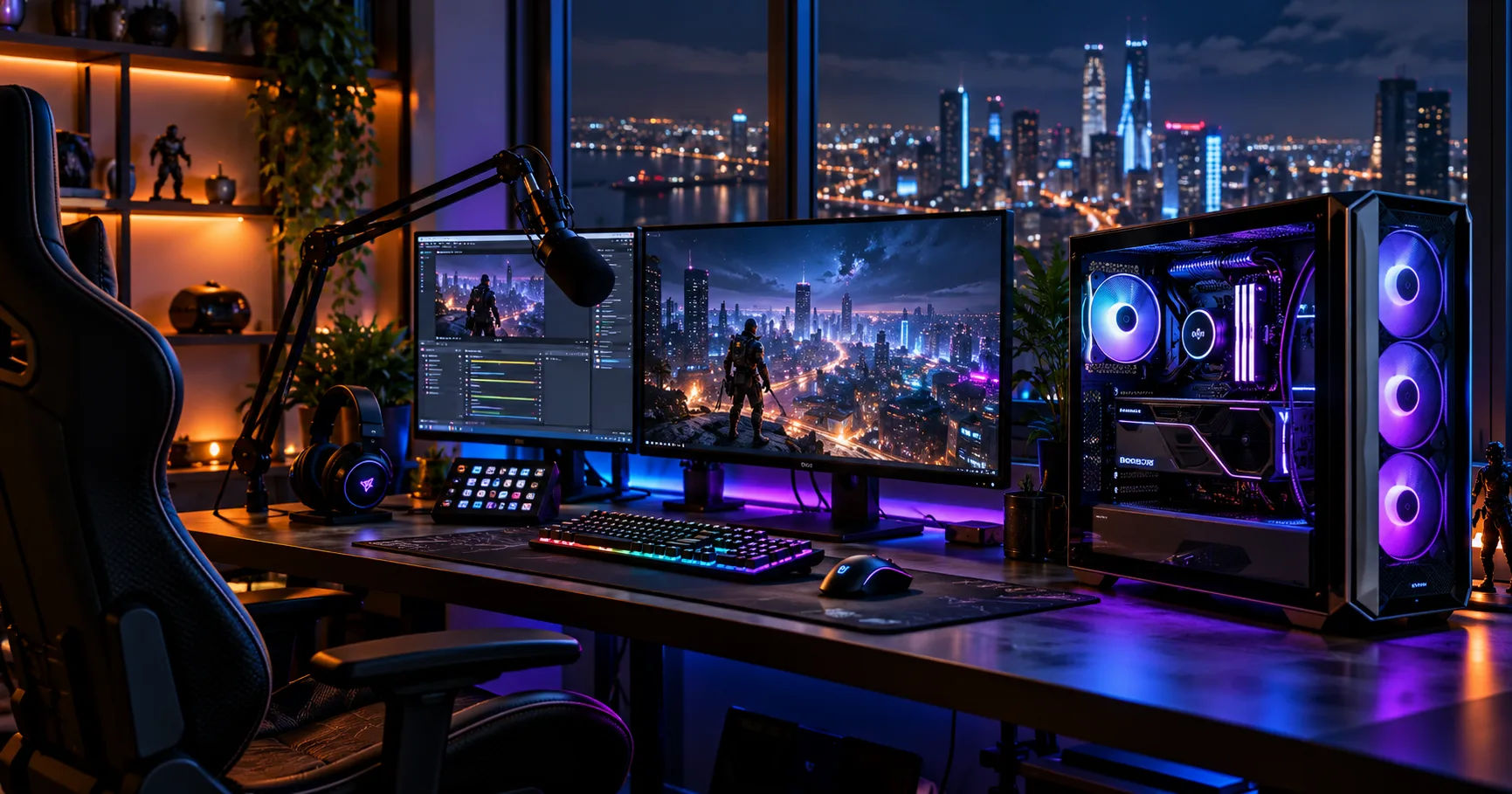 The good news is that modern high-end gaming hardware can handle demanding graphics features when configured correctly. A pc gamer ryzen 7 9800x3d rtx 5080 combines a powerful gaming processor with a high-performance graphics card, making it an excellent choice for players interested in advanced visual effects. This combination is designed to deliver high frame rates, detailed environments, and support for demanding graphics settings in compatible games.
Whether you enjoy competitive shooters, realistic racing simulators, open-world adventures, or cinematic role-playing games, ray tracing can make your experience more immersive. Nevertheless, understanding how ray tracing works, which settings to use, and how it affects performance will help you get the most from your computer.
What Is Ray Tracing in PC Gaming?
Ray tracing in pc gamer ryzen 7 9800x3d rtx 5080 is a graphics technology that simulates how light behaves when it interacts with objects in a virtual environment. Traditional rendering methods often use approximations to create lighting, reflections, and shadows. Ray tracing uses calculations that follow the paths of light rays to produce more realistic visual effects.
For example, imagine walking through a city in a modern action game. A traditional rendering system might display buildings and roads with carefully designed reflections. With ray tracing enabled, the game can produce reflections that respond more naturally to surrounding objects, lighting, and movement.
This technology can improve several aspects of a game's appearance.
Realistic Lighting
Ray-traced lighting can make indoor and outdoor environments appear more natural. Light can interact with surfaces in ways that create convincing brightness, color, and depth.
For instance, sunlight entering a room through a window may illuminate nearby walls and objects more realistically. This helps environments feel less artificial.
Improved Reflections
Reflections are another major advantage. Glass windows, polished floors, water, and vehicle surfaces can reflect surrounding objects with greater accuracy.
In racing games, ray-traced reflections can make car paint and windshields look more convincing. In open-world games, reflections can add detail to rainy streets, shop windows, and bodies of water.
More Accurate Shadows
Ray tracing can produce shadows that respond naturally to light sources and objects. Shadows may become softer or sharper depending on the distance between the object, the surface, and the light source.
These improvements can create a more believable environment without requiring developers to manually design every shadow and reflection.
Can a Ryzen 7 9800X3D and RTX 5080 Run Ray Tracing?
Yes. A PC equipped with the Ryzen 7 9800X3D and GeForce RTX 5080 can run ray tracing in supported games. This hardware combination is particularly suitable for gamers who want high-resolution graphics, advanced lighting effects, and strong gaming performance.
The two main components have different responsibilities. The processor handles game logic, artificial intelligence, physics, and other calculations, while the graphics card renders the visual elements and performs much of the work associated with ray tracing.
How the Ryzen 7 9800X3D Helps
The AMD Ryzen 7 9800X3D is an eight-core, sixteen-thread desktop processor built on AMD's Zen 5 architecture. Its 3D V-Cache technology provides a large amount of additional cache memory, which can help improve performance in games that benefit from rapid access to frequently used data.
This is especially useful in CPU-intensive games, large multiplayer matches, and situations where maintaining high frame rates matters.
Although the processor does not directly provide the RTX 5080's ray-tracing capabilities, it helps prevent CPU limitations from reducing the graphics card's potential performance.
How the RTX 5080 Handles Ray Tracing
The NVIDIA GeForce RTX 5080 is built on the Blackwell architecture and includes dedicated ray-tracing hardware. These specialized resources accelerate calculations used to produce realistic lighting, shadows, and reflections.
The card also supports NVIDIA DLSS technologies, including compatible frame-generation features, which can help improve performance in supported games.
Together, these capabilities make the RTX 5080 well suited to demanding graphics settings. Actual results will depend on the game, resolution, ray-tracing quality, and other system components.
Which Ray-Tracing Settings Should You Use?
The best settings depend on whether you prioritize image quality, frame rate, or a balance between the two.
A high-end system gives you more flexibility, but selecting every option at its maximum level is not always the best approach. Some effects require substantially more processing than others.
Low and Medium Ray Tracing
Low or medium ray-tracing settings can provide noticeable visual improvements while placing less pressure on the graphics card.
These settings are useful when you want smoother gameplay in demanding titles. They can also be a good starting point if you are unfamiliar with the performance impact of individual effects.
Try enabling ray-traced reflections or lighting first, then compare the results with the game's standard rendering mode.
High Ray Tracing
High settings provide a stronger visual upgrade in games with well-implemented ray tracing. Reflections, shadows, and lighting may appear more detailed and consistent.
A PC built around this processor and graphics card should be capable of running many ray-traced games at high settings. However, performance will vary considerably between titles.
Some games use ray tracing for only one or two effects, while others use it throughout the environment.
Ultra and Path Tracing
Ultra settings can deliver impressive image quality, but the performance cost can be significant.
Path tracing is even more demanding. Rather than applying ray tracing to selected effects, it uses a more comprehensive approach to simulate lighting throughout a scene.
Games that implement path tracing can look dramatically different, but even powerful graphics cards may need upscaling or frame generation to maintain high frame rates at demanding resolutions.
For the best experience, test these settings instead of assuming that maximum quality will always produce the most enjoyable gameplay.
Can You Play Ray-Traced Games at 1440p and 4K?
One of the main advantages of a powerful graphics card is the ability to play at higher resolutions. The RTX 5080 is designed for demanding gaming workloads, including high-resolution gaming with advanced visual effects.
However, resolution has a direct impact on performance because higher resolutions require the graphics card to process more pixels.
Ray Tracing at 1440p
A resolution of 2560 × 1440 offers an excellent balance between sharp visuals and performance.
At this resolution, the RTX 5080 has more room to maintain high frame rates while enabling ray-traced effects than it would at 4K in similarly demanding conditions.
This makes 1440p an appealing choice for gamers who use high-refresh-rate monitors and want both attractive graphics and responsive controls.
If you play competitive games, you can also disable the most demanding effects when they offer little practical benefit.
Ray Tracing at 4K
A resolution of 3840 × 2160 provides greater image detail, particularly on larger displays.
The RTX 5080 is a strong option for 4K gaming, and its ray-tracing hardware can make compatible games look impressive at this resolution. However, demanding titles may require DLSS to achieve a suitable balance between image quality and performance.
Your actual frame rate will depend on whether you use standard ray tracing, ultra settings, or path tracing.
For example, a less demanding game may run comfortably at 4K with ray tracing enabled, while a graphically intensive title may require more aggressive upscaling and adjusted settings.
What About 1080p Gaming?
At 1920 × 1080, the graphics card has fewer pixels to process, which can make demanding effects easier to run.
However, some games become limited by processor performance at lower resolutions, especially when aiming for very high frame rates. The Ryzen 7 9800X3D is particularly attractive for this type of gaming.
Although 1080p is less demanding, gamers purchasing this class of hardware may prefer 1440p or 4K to take fuller advantage of the graphics card's capabilities.
How DLSS Improves Ray-Tracing Performance
Deep Learning Super Sampling, commonly known as DLSS, is an important feature for gamers who want to use ray tracing without sacrificing too much performance.
DLSS uses AI-based techniques to help render games more efficiently. Depending on the game and supported hardware, it can improve performance while preserving much of the image detail.
DLSS Super Resolution
DLSS Super Resolution renders the game internally at a lower resolution and reconstructs an image intended to resemble the selected output resolution.
For example, a game displayed at 4K may render internally at a lower resolution before the reconstruction process produces the final image.
This reduces the amount of rendering work required and can improve frame rates when the graphics card is under heavy load.
Frame Generation
Supported DLSS Frame Generation features can create additional frames between traditionally rendered frames.
This can make gameplay appear smoother, particularly in graphically demanding games where conventional rendering produces a lower frame rate.
However, generated frames are not the same as frames rendered directly by the game engine. Frame generation does not automatically improve input responsiveness in the same way that increasing the native frame rate does.
For competitive gaming, prioritize strong base performance and low latency. For cinematic single-player games, frame generation may provide a worthwhile improvement in perceived smoothness.
Ray Reconstruction
In supported games, DLSS Ray Reconstruction uses AI to help reconstruct ray-traced image details. It can replace certain traditional denoising processes and improve the appearance of reflections, lighting, and other effects.
The results depend on the game's implementation, so it is worth comparing the available options.
For many players, DLSS makes demanding ray tracing more practical without requiring them to reduce every graphics setting.
Which Games Benefit Most From Ray Tracing?
Not every game uses ray tracing in the same way. Some titles offer modest improvements, while others transform their visual presentation when advanced lighting is enabled.
Cyberpunk 2077
Cyberpunk 2077 is a strong example of a game that benefits from advanced ray-tracing effects. Its futuristic city contains glass buildings, reflective roads, complex lighting, and brightly illuminated streets.
Path tracing can make these environments look significantly more realistic, although it can also place a heavy workload on the GPU.
An RTX 5080 system is a suitable platform for experimenting with these settings, particularly when DLSS is available.
Alan Wake 2
Alan Wake 2 uses sophisticated lighting and atmospheric effects to create a cinematic experience.
Ray tracing can improve the way light interacts with dark interiors and reflective surfaces. These effects contribute to the game's visual mood, making it a useful example of why some players prioritize image quality over maximum frame rates.
Minecraft With Ray Tracing
Compatible Minecraft editions and supported implementations can use ray tracing to improve lighting, reflections, and shadows.
The difference can be substantial when comparing a conventional environment with one that uses realistic lighting effects.
A powerful GPU can help maintain a more enjoyable experience with demanding ray-traced environments and high-resolution textures.
Other Supported Games
Many additional titles support ray tracing in some form, including racing games, action adventures, and first-person shooters.
Before buying a game specifically for its visual features, check its graphics options. Ray tracing is not available in every title, and different games may support different effects.
Will Ray Tracing Affect Gaming Performance?
Yes. Ray tracing generally reduces performance because it adds calculations that the graphics card must perform.
The size of the reduction depends on the game's engine, resolution, ray-tracing implementation, and selected quality settings.
A less demanding ray-traced effect may have a relatively small impact, while path tracing can cause a much larger performance drop.
GPU Performance
The graphics card usually handles the largest share of the additional rendering workload.
The RTX 5080's dedicated ray-tracing hardware is designed to accelerate this work. Nevertheless, its capabilities do not eliminate the performance cost of complex lighting calculations.
If your frame rate drops below your preferred level, reduce the ray-tracing quality, enable DLSS, or lower other demanding graphics settings.
CPU Performance
The Ryzen 7 9800X3D can help maintain high frame rates by handling game logic and preparing work for the graphics card.
In CPU-heavy games, its gaming-oriented design can be particularly valuable. However, a faster processor cannot eliminate a GPU bottleneck when ray tracing is the main source of reduced performance.
It is important to understand that both components contribute to the overall experience, but they address different limitations.
Memory and Storage
System memory also matters. For a high-end gaming PC, 32 GB of RAM is a sensible starting point for modern gaming, multitasking, and background applications.
Fast solid-state storage can improve loading times and asset streaming in supported games. Although an SSD does not directly increase ray-tracing performance in the same way as a faster GPU, it contributes to a more responsive overall system.
How to Optimize Your PC for Ray Tracing
A powerful graphics card is only one part of a well-configured gaming computer. A few practical adjustments can help you get better results from your hardware.
Keep Graphics Drivers Updated
Install current, compatible NVIDIA graphics drivers. Updates can introduce game-specific optimizations, fix rendering problems, and improve compatibility with new releases.
If you experience problems after a driver update, check the game's known issues and NVIDIA's release information before changing multiple settings at once.
Monitor Temperatures
High-performance components generate considerable heat under demanding workloads.
Use a well-ventilated case with appropriate cooling, and ensure that fans are configured correctly. Regularly remove accumulated dust from filters and heatsinks.
Monitoring CPU and GPU temperatures can help identify cooling problems before they affect sustained performance.
Choose the Right Power Supply
The RTX 5080 has a substantial power requirement. NVIDIA specifies a 360-watt total graphics card power rating for its reference specifications, with a recommended system power supply of 850 watts.
The final requirement can vary with the particular graphics card, processor, and other components. Follow the manufacturer's recommendations for your exact model.
Choose a reputable power supply with the correct connectors and sufficient capacity. Proper cable installation is also important for safe, reliable operation.
Balance Image Quality and Frame Rate
Do not assume that every ray-tracing option must be enabled.
Start with a preset that performs well, then enable the effects that provide the biggest visual improvement. Test the results in demanding areas of the game rather than relying only on menus or less intensive scenes.
For single-player adventures, a stable and visually pleasing frame rate may be preferable to chasing the highest possible number. For competitive games, responsiveness may matter more than advanced reflections.
Is This Hardware Combination Worth It for Ray Tracing?
For gamers who enjoy visually demanding games, the combination of the Ryzen 7 9800X3D and RTX 5080 is a compelling high-end option.
The processor offers strong gaming performance, while the graphics card provides dedicated ray-tracing hardware, modern upscaling support, and the ability to handle demanding resolutions.
The system is particularly attractive to people who want to play at 1440p with high frame rates or explore 4K gaming with advanced graphics.
However, value depends on your budget and gaming habits. If you mainly play esports titles with simple graphics, you may not benefit enough from ray tracing to justify spending more on a high-end GPU.
If you enjoy visually rich single-player games and want to explore the most demanding graphics settings, the additional capability may be worthwhile.
Consider Your Monitor
Your monitor influences how much you benefit from this hardware.
A high-refresh-rate 1440p monitor is a good choice for players who want both image quality and responsive gameplay. A 4K monitor is appealing to those who prioritize fine detail and cinematic presentation.
Consider adaptive-sync support, refresh rate, response time, and HDR performance alongside resolution. A good monitor helps you appreciate the graphics card's capabilities.
Plan for Future Games
Game requirements continue to evolve. New releases may introduce more complex lighting, larger environments, and additional AI-assisted graphics features.
The RTX 5080 provides a strong foundation for modern ray-traced gaming, but no graphics card can guarantee maximum settings and high frame rates in every future release.
Choosing a balanced system, maintaining it properly, and using available performance features will help extend its useful gaming life.
Conclusion
A PC equipped with the Ryzen 7 9800X3D and RTX 5080 can absolutely use ray tracing, and it is a strong combination for gamers who want realistic lighting, detailed reflections, and convincing shadows. The processor provides excellent gaming-focused performance, while the graphics card supplies the dedicated hardware needed to render demanding visual effects.
The most important consideration is choosing settings that match your preferred resolution and frame rate. At 1440p, you may have more flexibility to combine ray tracing with high-refresh-rate gaming. At 4K, DLSS and carefully selected graphics settings can help balance image quality and performance. Path tracing offers an even more advanced visual experience, but its greater demands may require additional compromises.
You should also consider cooling, power supply capacity, system memory, and driver updates when building or maintaining a high-end gaming PC. These details help ensure that your components perform reliably during long gaming sessions.
Ultimately, the pc gamer ryzen 7 9800x3d rtx 5080 is an excellent choice for exploring modern ray-tracing technology. It combines a capable gaming processor with a powerful graphics card, giving you the flexibility to enjoy immersive single-player adventures, detailed virtual environments, and demanding graphics settings. With the right configuration, you can experience the benefits of ray tracing while maintaining a smooth and enjoyable gaming experience.