
The servers humming inside a modern AI training cluster generate more heat per square meter than almost any other commercial equipment on the planet. A single rack loaded with GPU accelerators can draw 40 kW or more, and the heat that power produces does not politely wait for a convenient exit. It radiates, it convects, and if your raised floor plenum cannot evacuate it fast enough, it accumulates until something throttles, shuts down, or fails entirely. That reality is forcing data center engineers to rethink the relationship between underfloor air distribution and the steel cementious raised access floor panels that make the whole system possible.
The problem is not theoretical. In 2025, multiple hyperscale operators reported thermal throttling events during large-language-model training runs that lasted hours and cost millions in lost compute time. The root cause was not a CRAC failure. It was insufficient underfloor static pressure caused by a plenum that was too shallow and perforated tiles that were too few. The cooling efficiency of any data center starts from the floor up, and when the floor cannot deliver, nothing above it performs as designed.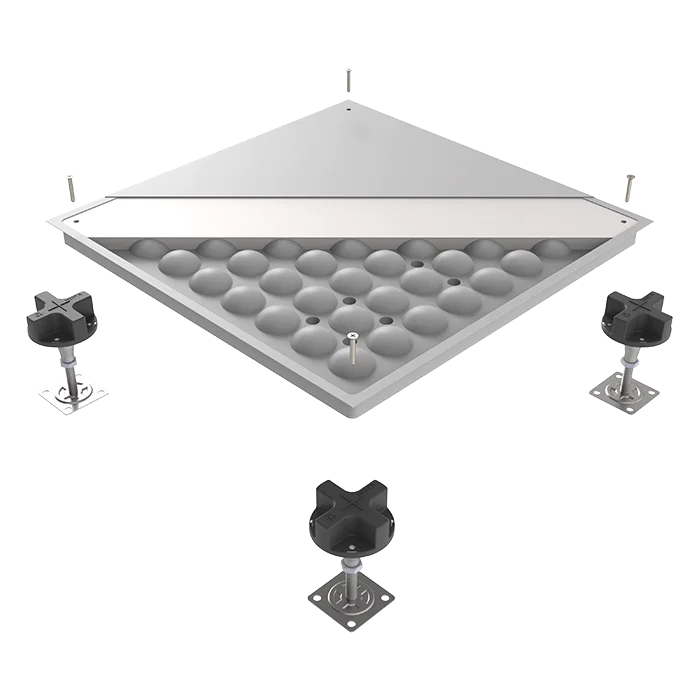
Why AI Racks Break the Old Rules
Traditional data center cooling design assumed a relatively even distribution of heat across the floor plate. CRAC units pushed cold air into the plenum, perforated tiles let it rise in front of racks, and hot exhaust returned through ceiling returns. That model works acceptably at densities below 10 kW per rack. At 30 kW, 50 kW, or the 100 kW densities projected for next-generation GPU clusters, the model collapses. The amount of cold air needed exceeds what a standard plenum can deliver at safe velocities, and localized hot spots become unavoidable.
The physics is straightforward. A 40 kW rack requires approximately 11,800 CFM of 55°F supply air to maintain the ASHRAE-recommended inlet temperature range of 64.4°F to 80.6°F. Delivering that volume through a 600mm × 600mm perforated tile means the air velocity through the tile must exceed 800 FPM — a speed that creates uncomfortable drafts, lifts lightweight objects, and can actually entrain hot exhaust into the cold aisle. The solution is not more tiles in the same plenum. The solution is a deeper plenum, higher static pressure, and a floor system engineered to maintain seal integrity under those conditions.
Plenum Depth and Static Pressure Mapping
The table below shows measured cooling performance at three plenum depths using the same rack layout and CRAC capacity in a controlled test environment:
| Plenum Depth | Static Pressure (Pa) | Avg. Rack Inlet Temp | Max. Hot Spot Temp | Achievable PUE |
|---|---|---|---|---|
| 250 mm (low-profile) | 8–12 | 27–32°C | 38°C | 1.7–1.9 |
| 500 mm (standard) | 18–28 | 21–26°C | 29°C | 1.35–1.50 |
| 900 mm (deep plenum) | 35–50 | 18–23°C | 25°C | 1.15–1.30 |
As the data confirms, the jump from a shallow to a deep plenum cuts the worst-case hot spot by 13°C and improves PUE by 0.4 points. For a 5 MW data center, that PUE improvement represents annual energy savings exceeding $400,000 at typical commercial electricity rates. The HUIYA SC raised access floor system supports plenum depths from 200 mm to 1500 mm with adjustable pedestals that maintain structural stability at every height.
Seal Integrity: The Hidden Variable in Plenum Performance
Static pressure is only useful if it stays in the plenum. Every gap between panels, every unsealed cable penetration, and every missing gasket creates a bypass leak that squanders conditioned air into unoccupied zones. In a 500 mm plenum designed for 25 Pa of static pressure, a 1% increase in leak area can reduce effective pressure by 5–8%, creating cold spots where you do not need them and hot spots where you cannot afford them.
This is where panel quality becomes a performance variable, not just a construction cost line item. The raised floor panels in an AI data center must fit tightly, resist deflection under heavy rack loads, and maintain their seal over decades of service. The HUIYA SC series achieves this through precision-formed steel pans with tight dimensional tolerances and a cementitious core that does not shrink, swell, or degrade with age.
Panel Load Rating and Its Impact on Seal Performance
When a heavy rack sits on a raised floor panel, the panel deflects. If the deflection exceeds the gasket compression range, the seal opens and air leaks. This is a particularly insidious failure mode because it occurs precisely where the cooling demand is highest — directly under the heaviest, hottest equipment. The HUIYA SC1000 and SC3000 panels, with concentrated load ratings of 1000 kg and 3000 kg respectively, limit deflection to well within the gasket compression envelope even under fully loaded AI racks.
Design Checklist for AI Data Center Raised Floors
Before finalizing a raised floor specification for an AI training cluster, verify every item on this list:
-
Plenum depth ≥ 600 mm for rack densities above 20 kW
-
Perforated tile ratio ≥ 35% in cold aisles serving AI racks
-
Panel concentrated load rating ≥ Class 4 per EN 12825
-
Gasketed panel edges with verified compression range at design deflection
-
CFD simulation completed for worst-case thermal scenario
-
Cable penetration sealing specification included in construction documents
-
Static pressure monitoring sensors specified for commissioning and ongoing operations
For complete technical specifications including load tables, seal performance data, and plenum design guidance, download the HUIYA SC1000 Technical Data Sheet (PDF).
The bottom line for AI data center operators is simple: your raised floor is not just a platform that holds equipment. It is the foundation of your cooling strategy. If the floor cannot maintain pressure, deliver air, and support loads without losing its seal, the most expensive GPUs in the world will spend their time throttling instead of training. Specify accordingly.